

Laterite steps leading down to a pond with a stone statue in the Hortus Malabaricus Botanical Garden
Research

Our research

From sequencing Indian genomes to studying the plants of the Western Ghats, we back research that matters for India but is rarely funded elsewhere.

Overview

Two chapters of research

For its first twelve years, SGRF focused on genomics. With our scientific advisory board, we chose projects that are important for India but rarely funded by government agencies, and worked with academic, medical and industry partners across agriculture, animal health, biodiversity and human health. Every one of these projects is now complete, and their results are published in peer-reviewed journals, including Nature and Nature Genetics.

Today our research centres on plants. At the Hortus Malabaricus Botanical Garden and Research Institute (HMBGRI), set up in 2025, our scientists study the plants described in Hortus Malabaricus, the traditional plant knowledge of Kerala, the plants of Ayurveda, and the rare and threatened flora of the Western Ghats.

Current research at HMBGRI

Studying the plants of Kerala and the Western Ghats

Four research programmes run at our institute in Cheruthuruthy.

New · Beta

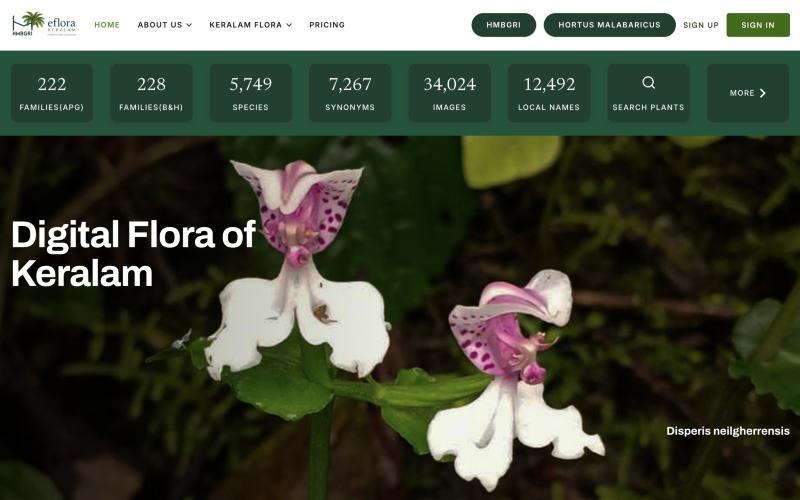
eFlora Keralam: an online flora of Kerala

eFlora Keralam is HMBGRI's new online database of the flowering plants of Keralam, with more than 5,700 species, 12,000 local names and 34,000 photographs. You can browse plants by family (in both the APG and Bentham & Hooker systems), species, synonyms and local names, search the database and view plant photographs. Dr N. Sasidharan, a member of our advisory board, was the original curator, and the plant details come from a number of contributors.

The beta version is now live. Part of the database is free to use, and full access is available for a small fee.
Visit eFlora Keralam ↗

Home page of eFlora Keralam, showing counts of families, species, synonyms, images and local names above a photograph of an orchid
Ongoing

Selected Hortus Malabaricus plants

The 17th-century Hortus Malabaricus describes 742 plants of the Malabar coast and their uses. We are studying selected plants from the book, combining their history and botany with modern scientific methods.

Ongoing

Ethnobotany of Kerala

A systematic record of the traditional medicinal plant knowledge of Kerala's indigenous communities. Our team carries out field surveys and documents plant uses with the communities that hold this knowledge.

Ongoing

Genomics of Ayurveda plants

Genomic studies of key medicinal plants used in Ayurveda, bringing SGRF's experience in genome sequencing to the plants grown in our Ayur Udhyan garden.

Ongoing

Rare, endangered and threatened plants

Research on the rare, endangered and threatened (RET) plants of the Western Ghats, one of the world's biodiversity hotspots, to support their conservation.

Visit hmbgri.org ↗

Completed projects

Genomics research, 2010–2022

Each project is listed with its main publication, newest first.

  1. 2021Completed

    Familial cancer genomics

    India carries 20% of the world's burden of retinoblastoma, a childhood eye cancer that is often inherited. SGRF and clinical partners screened 50 children with retinoblastoma for inherited mutations in the RB1 gene using next-generation sequencing. The study found 20 variants, three of them new, and showed that genetic results help doctors decide on treatment and follow-up.

  2. 2020Completed

    The Indian cobra genome

    Snakebite kills about 50,000 people a year in India, yet antivenom is still made by a method more than a century old. SGRF and partners built a high-quality reference genome of the Indian cobra and identified 19 key venom toxin genes, a starting point for safer, synthetic antivenoms. The study was the cover story of Nature Genetics.

  3. 2019Completed

    Human genetic variation in India

    Most genetic reference databases are built from European populations, so variants common in India can be mistaken for disease-causing ones. SGRF worked with academic and medical partners to map genetic variation across the subcontinent. This work fed into the GenomeAsia 100K study, which sequenced 598 people from 55 Indian ethnic groups and was the cover story of Nature.

  4. 2019Completed

    Coloured rice genomics

    India grows thousands of traditional rice varieties, but few have been sequenced. Purple Puttu, a Tamil Nadu landrace used to make the breakfast dish puttu, has purple grains and leaves rich in anthocyanins. SGRF sequenced its whole genome and compared it with other rice genomes to find the gene variants unique to this purple rice.

  5. 2018Completed

    Tea looper biopesticide

    Tea looper caterpillars strip tea bushes across Assam and West Bengal, which produce about two-thirds of India's tea, and chemical pesticides leave residues that hurt prices. Nuclear polyhedrosis viruses that infect the caterpillars could become natural biopesticides. SGRF produced the complete genome and transcriptome of one such virus using single-molecule sequencing.

  6. 2018Completed

    Wild elephant viral disease

    Elephant endotheliotropic herpesviruses (EEHV) cause a haemorrhagic disease that kills most young elephants it infects. Working with wildlife veterinarians in the Nilgiri Biosphere Reserve, home to the largest wild Asian elephant population, SGRF studied the virus in 22 fatal cases among wild and captive elephants in India.

All publications